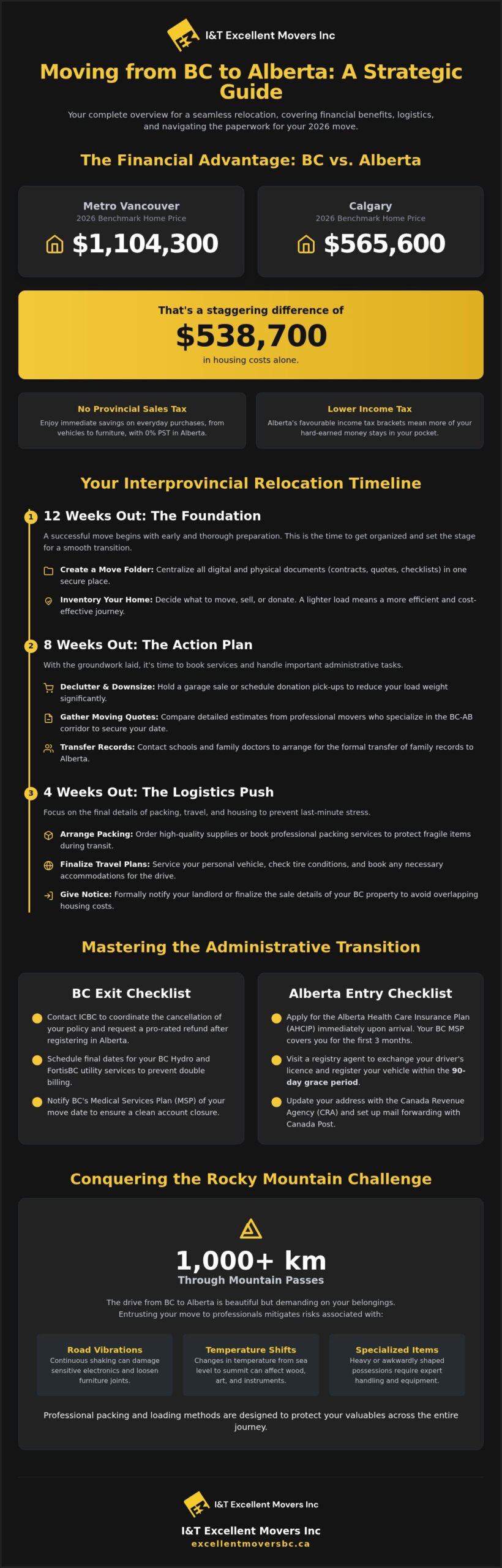
In 2026, the benchmark price for a home in Metro Vancouver reached $1,104,300, nearly double the $565,600 price tag for a similar property in Calgary. This staggering gap is a primary reason why moving from bc to alberta is a strategic choice for those seeking financial freedom. You likely recognize that while the destination is promising, the journey involves complex logistics. It’s common to feel some anxiety when considering the drive through the Rockies or the shift from ICBC to Alberta’s private insurance system.
We are here to lighten that burden with professional, reliable advice. This guide promises to help you master every step of your relocation with a clear strategy covering logistics, paperwork, and cost-saving tips. We will provide a complete 2026 relocation checklist and explain how to navigate the provincial border with total confidence.
Key Takeaways
- Begin your relocation journey at least 12 weeks early by creating a central move folder to manage all digital and physical documents.
- Master the administrative transition of moving from bc to alberta by coordinating your ICBC cancellation with Alberta’s 90-day grace period for health care and driver’s licences.
- Ensure the safety of your possessions during the 1,000km mountain haul by using professional packing methods designed to withstand road vibrations and summit temperature changes.
- Capitalize on Alberta’s financial benefits, including the absence of provincial sales tax and lower income tax brackets compared to British Columbia.
- Alleviate the stress of a multi-day interprovincial trip by entrusting heavy or specialized items to experts who understand the unique challenges of the Rockies.
Preparing Your Interprovincial Relocation: A Step-by-Step Timeline
A smooth transition starts long before the truck arrives at your door. When you are planning for moving from bc to alberta, the vast distance and geographical challenges of the Rockies require a methodical approach. Most successful relocations begin 8 to 12 weeks in advance. This lead time allows you to manage the physical load while staying on top of the administrative requirements that come with changing provinces. The historical patterns of interprovincial migration in Canada suggest that this specific route is a popular path for those seeking new opportunities, meaning high-quality movers often book up months in advance.
Create a central Move Folder immediately. Whether you prefer a physical binder or a secure digital drive, this is where you’ll store your contracts, inventory lists, and utility notices. Having everything in one place reduces the mental burden and ensures you aren’t searching for critical paperwork while in the middle of a mountain pass. It’s the foundation of an organized, stress-free experience.
Inventorying your home is a vital step in this early phase. Every kilogram adds to the effort of hauling items over the mountain summits. Be honest about what is worth the journey. If a piece of furniture won’t fit the aesthetic of your new Alberta home or is nearing the end of its life, it’s better to rehome it in BC than to pay for its transport. This process helps you secure a more accurate quote and simplifies your packing later on.
The 8-Week Master Checklist
Start by decluttering every room in your home. A garage sale or a donation run can significantly reduce your load weight, making the logistics much simpler for everyone involved. This is also the ideal time to gather long distance moving quotes. Comparing detailed estimates helps you understand the scope of the work and secure your preferred date with a team that knows the BC-AB corridor. Finally, contact your children’s schools and your family doctor to request a formal transfer of records. Having these documents ready ensures your family has a seamless transition to Alberta’s systems.
The 4-Week Logistics Push
As your date approaches, the focus shifts to the fine details. Order high-quality packing supplies that can handle the vibrations of a 1,000 kilometre journey, or consider booking professional packing services to ensure your fragile items are protected. You should also finalize your own travel plans. If you are driving your own vehicle while moving from bc to alberta, check your maintenance records and ensure your tires are rated for mountain conditions. Lastly, give formal notice to your landlord or finalize the listing details for your BC property to avoid any overlapping costs.
Navigating the Paperwork: From ICBC to Alberta Health Services
Relocating involves a significant amount of administrative coordination. While you focus on the physical logistics, you must also manage the transition between two distinct provincial systems. Moving from bc to alberta gives you a 90-day grace period to update your driver’s license and vehicle registration. However, health care coverage works differently. You should apply for the Alberta Health Care Insurance Plan (AHCIP) as soon as you arrive, even though your BC Medical Services Plan (MSP) generally covers you for the first three months of your residency. Ensuring every household member has valid government-issued identification ready will make these registry visits much more efficient.
Precision is essential when coordinating your insurance. You must keep your BC insurance active until your vehicle is safely in Alberta and a new policy is ready to take effect. Cancelling too early could leave you unprotected during the mountain transit. Additionally, remember to update your address with the CRA and set up mail forwarding with Canada Post. These steps prevent gaps in your tax records and ensure that important documents find their way to your new doorstep.
The BC Exit: Closing Your Accounts
Closing your BC accounts requires a methodical approach to avoid double billing or service gaps. Contact ICBC to discuss your insurance refund; you’ll typically receive a pro-rated amount for any unused months on your policy once you provide proof of your new Alberta registration. You also need to schedule disconnection dates for BC Hydro and FortisBC services. Finally, notify MSP of your move date. This ensures your account is properly closed in British Columbia while you wait for your Alberta coverage to activate, keeping your transition clean and organized.
The Alberta Entry: Setting Up Your New Life
Once you cross the border, your first stop should be an Alberta Registry office. Here, you can exchange your BC driver’s license for an Alberta one for a fee of $98.65. You also have 90 days to register your vehicle. Unless your car is less than four years old, Alberta requires an out-of-province vehicle inspection to ensure it meets local safety standards. This inspection typically costs between $169 and $250. If the administrative burden feels heavy, focusing on one task at a time is the best way to maintain peace of mind. Our team of BC long distance movers can handle the physical transit, giving you the time needed to navigate these registry requirements with ease.
Packing and Logistics: Crossing the Canadian Rockies Safely
Moving from bc to alberta involves more than just mileage; it’s a test of endurance for your belongings. The 1,000 kilometre journey across the Canadian Rockies introduces physical stressors that don’t exist in local relocations. Constant road vibration and rapid elevation changes can cause items to shift or settle in ways that damage fragile surfaces. While a short trip across town might be forgiving, this interprovincial route demands a higher level of precision. Every container needs to be packed with the understanding that it will face steep grades and hours of motion before reaching its destination.
Establishing a clear inventory is essential when moving from bc to alberta. Labeling is your best tool for staying organized during the first few days in your new home. Mark each box by room and priority level so you can establish a “centre” of operations quickly, focusing on the kitchen and bedrooms first. For specialized items like pianos or heavy gym equipment, climate-controlled transport and professional bracing are often necessary. These pieces require specific expertise to withstand the sharp turns and temperature fluctuations inherent in mountain travel, particularly when crossing summits like the Coquihalla or Rogers Pass.
Packing for the Long Haul
Protection begins from the inside out. We recommend using double-walled boxes for any heavy items, as standard cardboard can easily burst under the pressure of a multi-day journey. Every fragile item needs thick internal cushioning to absorb the shocks of the road. Wrap your furniture in professional-grade moving blankets to prevent scuffing and structural stress during transit. It’s also wise to pack a clearly marked “Essentials Box” that stays with you. This should include:
- Basic toiletries and personal medications
- Phone chargers and essential electronics
- Bedding and towels for the first night
- Small tools for reassembling furniture
This simple step ensures you have peace of mind during your first night in your new Alberta home without needing to unpack every container immediately.
The Mountain Crossing Challenge
The geography of the BC-Alberta border presents seasonal challenges that require careful planning. If your move occurs between October 1 and April 30, BC law requires winter tires or chains for most mountain highways. These regulations are strictly enforced to ensure safety on steep, icy grades. Variable weather can turn a clear day in the valley into a blizzard at the summit within minutes. Ensure your moving vehicle is fully prepared for these shifts. To maintain focus, plan your route with designated stops every few hours. Avoiding driver fatigue is the most important factor in a safe crossing, allowing you to arrive at your new destination refreshed and ready to begin.
Cost of Living Realities: British Columbia vs. Alberta in 2026
Financial clarity is often the strongest motivator for those moving from bc to alberta. In 2026, the economic landscape shows a clear divergence in how your income is spent. In British Columbia, the combined GST and PST results in a 12% tax on most goods and services. Alberta remains the only province without a provincial sales tax, leaving you with only the 5% federal GST. This 7% saving applies to almost every daily purchase, from your morning coffee to a new vehicle. BC is also expanding PST to cover professional services like accounting and engineering in October 2026, making the move to Alberta even more financially attractive for many households.
Income tax structures also play a significant role in your monthly budget. While BC offers a lower starting rate of 5.06%, Alberta’s 8% bracket covers the first $61,200 of income. For many professionals, this results in a lower overall tax burden and higher take-home pay. However, you should prepare for the reality of Alberta’s deregulated utility market. While fuel prices are typically lower at the pump, heating a home during a prairie winter can lead to higher electricity and natural gas bills compared to the milder BC climate. Balancing these factors is essential for a realistic financial plan.
Taxation and Daily Expenses
The absence of PST is a significant windfall for your household budget. When you calculate these savings over a full year, the impact on your disposable income is substantial. You’ll also find that fuel prices in Alberta are generally lower due to reduced provincial fuel taxes. To maximize these benefits, we recommend researching deregulated utility providers early. Choosing the right fixed or variable rate plan for your new home can help mitigate the costs of the longer heating season.
Housing and Insurance Shifts
The most dramatic difference lies in the real estate market. In March 2026, the benchmark price for a home in Calgary was $565,600, while Metro Vancouver sat at $1,104,300. This means your dollar buys nearly double the square footage, or allows you to live mortgage-free much sooner. Transitioning your vehicle also involves a shift from the public ICBC model to Alberta’s private insurance system. While this introduces more choice, you must factor in the cost of a mandatory out-of-province inspection. This safety check usually ranges from $169 to $250 and is a non-negotiable step for registering your vehicle in Alberta. If you’re ready to make the transition to a more affordable lifestyle, our residential moving services can help you get there with total peace of mind.
Why Professional Movers are Essential for a BC to Alberta Transition
The 1,000 kilometre trek across the provincial border is a significant logistical operation that extends far beyond simply loading a truck. Moving from bc to alberta involves navigating some of the most demanding terrain in North America, including steep mountain passes and unpredictable weather systems. While a DIY approach might seem like a way to manage costs, the hidden burdens of physical exhaustion and mental stress can be overwhelming. Professional crews take this weight off your shoulders, allowing you to focus on your family and your new career. By partnering with experts, you benefit from transparent, flat-rate pricing for moving long distance, providing the financial predictability you need during a major life change.
Safety is the most compelling reason to choose a professional team. Driving a large, unfamiliar rental truck through the winding curves of the Rockies is a high-risk task for those without specialized training. Professional drivers possess the experience needed to manage heavy loads on steep grades, ensuring your possessions arrive safely. This level of steady, quiet competence provides a foundation of trust that is essential when your entire household is in transit.
The Safety and Security Advantage
Professional packing services significantly reduce the risk of damage during the long haul. Experts use specific techniques to cushion items against the constant road vibrations that occur during mountain transit. Additionally, licensed movers provide insurance coverage that DIY moves typically lack. This protection ensures that if the unexpected happens, your investment is secure. Having a team that understands the specific challenges of the Coquihalla and Rogers Pass means you can travel to your new home with total confidence.
Specialized Handling for High-Value Items
Certain belongings require more than just a sturdy box. Piano moving, for example, demands specific equipment and bracing techniques to maintain stability over long distances. Our specialized crews understand how to protect the delicate internal mechanics of these instruments during elevation changes. We also offer tailored senior moving services, providing a compassionate and patient transition for older adults. For those relocating a business, commercial expertise ensures that heavy office equipment and gym machinery arrive ready for immediate setup. Moving from bc to alberta is a major milestone. Entrusting the details to a seasoned professional ensures your journey is defined by precision and care rather than logistical hurdles.
Embarking on Your Alberta Journey with Confidence
Moving from bc to alberta is a significant life transition that offers substantial financial rewards, including lower taxes and more affordable housing. A successful relocation depends on a methodical approach to your administrative checklist and a safe strategy for crossing the Rockies. By managing your timeline effectively and preparing for the shift in insurance and health care systems, you’ll turn a complex move into a predictable and positive experience.
Our team at I&T Excellent Movers is ready to serve as your trusted expert guide. We provide specialized piano and senior moving services with transparent, no-hassle pricing. Our expert crews are specifically trained for the BC-AB mountain route, ensuring your possessions are protected every kilometre of the way. Get a Free Long-Distance Moving Quote from I&T Excellent Movers and start your next chapter with total peace of mind. We look forward to helping you settle into your new community.
Frequently Asked Questions
How long does it take to move from BC to Alberta with a professional crew?
A professional relocation from BC to Alberta typically takes between 2 to 4 days. This timeline accounts for the loading process, the drive through the mountain passes, and the final unloading at your new residence. The exact duration depends on your starting point and destination. For instance, a move from Vancouver to Calgary is faster than one originating on Vancouver Island and heading to Edmonton.
Do I need a new vehicle inspection when moving from BC to Alberta?
Most vehicles require an Out-of-Province (OOP) inspection when moving from bc to alberta unless they are less than four years old. Vehicles previously registered in BC that meet this age requirement are often exempt. If an inspection is necessary, it must be performed by a licensed technician in Alberta. This safety check ensures your vehicle meets Alberta’s standards before you can complete your registration and obtain local plates.
How do I transfer my BC driver’s licence to Alberta?
You can transfer your licence by visiting any Alberta Registry agent within 90 days of your move. You’ll need to surrender your BC driver’s licence and provide proof of Alberta residency and legal entitlement to be in Canada. The fee for a 5-year licence is $98.65. Starting July 2, 2026, Alberta will also add your Personal Health Number directly to your new licence for easier access to services.
What is the best time of year to move across the Rockies?
The most reliable time to cross the Rockies is between May and September to avoid unpredictable winter weather. During these months, road conditions are generally clear, and you won’t face the mandatory winter tire regulations that apply from October 1 to April 30. Moving during the summer also provides more daylight hours for the long drive, making the journey through the mountain summits much safer and more comfortable.
Can I keep my BC health coverage until my Alberta health care starts?
Your BC Medical Services Plan (MSP) will continue to cover you for the balance of the month you move plus two additional months. This three-month rule ensures you aren’t without coverage while your Alberta Health Care Insurance Plan (AHCIP) application is processed. It’s vital to apply for AHCIP as soon as you arrive to ensure your new coverage begins exactly when your BC benefits expire.
How much should I budget for an interprovincial move in 2026?
Your budget should account for the volume of your belongings and the specific services you require, such as professional packing or piano moving. When moving from bc to alberta, you should also factor in administrative fees like the $100 registration fee for your vehicle and the cost of an out-of-province inspection. Requesting a transparent, flat-rate quote is the best way to ensure your financial planning remains accurate and stress-free.
What are the main differences between ICBC and Alberta auto insurance?
The main difference is moving from BC’s public, government-run ICBC system to Alberta’s private insurance market. In Alberta, you have the freedom to shop around with various private companies to find a policy that fits your specific needs and budget. While BC’s system is centralized, Alberta’s competitive market often provides more flexibility in coverage options and deductible levels for your vehicle insurance.
Is there a PST refund for items I bought in BC before moving?
There is no formal PST refund for goods you have already purchased and used in British Columbia. PST is a consumption tax paid at the point of sale within the province. While you won’t get money back for past purchases, you’ll immediately realize savings on all future spending in Alberta. The absence of a provincial sales tax means you’ll only pay the 5% federal GST on most goods and services.