What if the most dangerous part of your move isn’t the weight of your piano, but the specific geometry of your staircase? It’s a common realization for homeowners across British Columbia, where narrow hallways and unique heritage home layouts often turn a simple relocation into a complex logistical puzzle. You’ve likely felt a pang of anxiety while looking at your stairs, wondering about the potential cost to move a piano upstairs and whether your polished hardwood floors or drywall will survive the transition unscathed.
We understand that a piano is far more than just heavy furniture; it’s a delicate investment and a cherished part of your family’s history. This guide clarifies the specific factors that influence pricing, from step counts to the specialized equipment required for a safe vertical move. You’ll discover how professional crews protect your instrument’s structural integrity and what to look for to avoid unexpected fees. We’ll explore how specialized equipment, crew expertise, and staircase layout combine to determine your final estimate.
Key Takeaways
- Understand why staircase geometry and gravity play a larger role than weight when calculating the cost to move a piano upstairs.
- Identify the specific stair fees and base rates common in the BC moving industry to ensure your quote remains transparent and predictable.
- Learn how specialized equipment like piano skids and heavy-duty blankets prevent damage to your instrument and your home’s drywall or flooring.
- Discover why different piano types, from compact spinets to full-sized uprights, require distinct logistical approaches for a safe vertical transition.
- Gain insights into vetting local movers for essential WorkSafeBC compliance and specialized insurance coverage tailored for high-value instruments.
The Vertical Challenge: Why Moving a Piano Upstairs Costs More
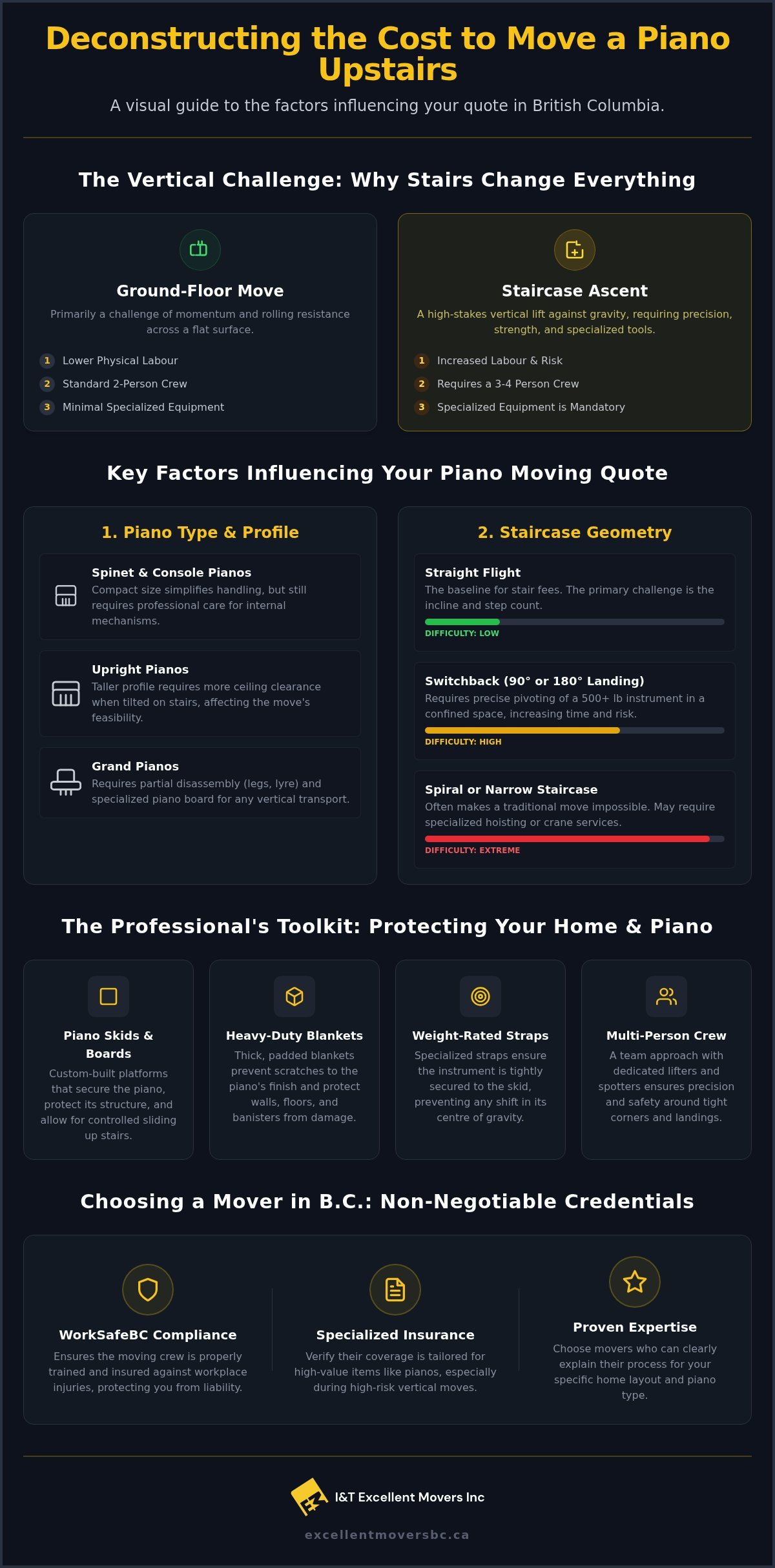
Moving a piano across a flat surface is primarily a matter of momentum and rolling resistance. However, once a staircase is involved, the physics of the move change entirely. The cost to move a piano upstairs reflects the transition from a horizontal roll to a high-stakes vertical lift. A stair surcharge is a necessary reflection of the increased physical labour, specialized equipment requirements, and heightened risk levels inherent in fighting gravity.
Professional movers in British Columbia typically calculate these fees based on the number of steps or full flights involved. This isn’t just an arbitrary fee; it covers the extra time needed to secure the instrument and the additional personnel required to ensure the piano doesn’t become a safety hazard. Standard moving insurance often covers basic transit, but vertical transport involves specific liability clauses. Because the potential for structural damage to the home or the instrument increases on a slope, specialized coverage ensures that your investment remains protected even in the most challenging architectural layouts.
Gravity vs. Your Instrument
When a piano is tilted at a 45-degree angle to ascend a flight of stairs, its internal centre of gravity shifts dramatically. This is particularly relevant for different types of pianos, as the weight distribution between a compact spinet and a tall upright varies significantly. Without being properly secured to a specialized skid, the delicate internal “action” can sustain permanent damage. Choosing professional piano moving services ensures the instrument is locked into place. This prevents the thousands of moving parts that produce sound from shifting or breaking during the ascent.
The Physical Toll on the Crew
A move that requires only two people on a ground floor often necessitates a four-person crew when stairs are introduced. This expansion isn’t just for muscle; it’s for safety and precision. One or two movers handle the primary lift, while a dedicated spotter manages the clearance of tight landings and corners. This team-based approach is vital for navigating the narrow hallways frequently found in Greater Vancouver homes. Safety protocols, including the use of heavy-duty straps and weight-rated skids, are strictly followed to prevent workplace injuries. Every step is a calculated movement designed to protect both the movers and your property.
Key Factors Influencing Your Piano Moving Quote
Determining the final cost to move a piano upstairs requires a detailed look at the physical environment of your home. While weight is a significant factor, the path of travel often dictates the complexity of the operation. Professional movers evaluate the specific dimensions of your instrument alongside the architectural constraints of your property to provide an accurate estimate. Every home in British Columbia presents unique challenges, from heritage houses with narrow corridors to modern condos with tight elevator access.
Categorizing Your Piano Type
The physical profile of your instrument changes the mechanics of the lift. For upright pianos, the height of the backboard is critical because it determines the angle at which the crew must tilt the instrument on the skid. A tall upright requires more clearance than a compact spinet or console model. Grand pianos present a different challenge; they require partial disassembly, including the removal of legs and the lyre board, before they are secured to a piano board for vertical transport. Digital pianos are generally the exception, as their lighter frames often allow for more flexible handling. If your digital instrument is under 200 pounds, you might find more flexibility in moving options compared to a traditional acoustic model.
Staircase Difficulty Levels
The geometry of your stairs is the most influential variable in your quote. Standard straight flights serve as the baseline for vertical fees. However, switchback stairs with 90-degree landings require a 500-pound instrument to be pivoted in a confined space. This manoeuvre demands extreme precision to avoid wall damage or structural strain. If you have a spiral or exceptionally narrow staircase, traditional lifting might be physically impossible. In these rare cases, specialized hoisting or crane services might be the only safe way to reach an upper-floor window or balcony. Ceiling height also plays a silent but vital role; if the clearance is too low when the piano is tilted, the move cannot proceed without alternative equipment.
Beyond the stairs themselves, we account for the ‘long carry’ distance from the truck to the first step, which adds to the total labour time. Property protection is another essential factor. We use protective floor runners and door jamb pads to safeguard your hardwood and drywall from accidental scuffs. To ensure all these variables are accounted for, you can request a professional assessment to receive a quote tailored to your home’s specific layout.
Estimated Cost Breakdown for Moving a Piano Upstairs
Understanding the final invoice for a piano move requires a look at how professional logistics companies in British Columbia structure their pricing. Most quotes are divided into two distinct categories: the base rate and variable surcharges. The base rate covers the fundamental costs of the truck, the primary crew, and the transit time between locations. However, the cost to move a piano upstairs is primarily driven by the variable fees associated with the architectural challenges of your home. While base costs provide a starting point for ground-floor logistics, the addition of stairs typically introduces a specific surcharge that reflects the heightened physical demand and risk.
In the BC moving industry, these stair fees are often calculated per flight or even per individual step. This granularity ensures that you only pay for the specific effort required. If a move is particularly complex, such as navigating a multi-storey heritage house, the requirement for extra labour becomes a factor. While a standard move might utilize two or three professionals, vertical transitions often necessitate a fourth crew member to act as a safety lead and spotter. This additional expertise is a key component in maintaining a damage-free environment for both your instrument and your property.
Typical Stair Surcharges in 2026
The first flight of stairs, usually defined as a set of 10 to 12 steps, serves as the standard benchmark for vertical billing. It’s common for subsequent flights to carry a slightly different weight in the quote. This accounts for the “fatigue factor,” as the physical toll on the crew increases with every additional level they must ascend. Tight turn fees may also apply if the staircase includes landings that require complex manoeuvring. These architectural bottlenecks demand more time and precision, which is reflected in the final labour tally.
Hidden Costs to Watch For
Beyond the physical move, several external factors can influence your budget. After-hours or weekend premiums are common in residential buildings with strict move-in windows. If your home is located outside the Greater Vancouver core, fuel surcharges and travel time fees will likely be added to the total. One essential post-move expense is professional tuning. Because the tension of the strings is sensitive to changes in humidity and the physical stress of transport, you should budget for a technician to visit about two weeks after the relocation. This waiting period allows the piano to settle into its new environment before the fine-tuning process begins.
The Professional Process: How We Protect Your Home and Piano
When you evaluate the cost to move a piano upstairs, you aren’t just paying for physical labour; you’re investing in a refined system of protection designed to safeguard your most valuable possessions. A successful vertical move relies on a combination of high-grade materials and a methodical approach that eliminates guesswork. We treat your home with the same level of care as the instrument itself, ensuring that every hallway, door frame, and stair tread remains in its original condition throughout the process.
The “Piano Board” technique is the cornerstone of this professional approach. Rather than attempting to lift the full weight of the instrument with every individual step, which creates uneven pressure and high risk, we utilize a specialized skid to create a controlled slide. This method allows the crew to maintain a consistent centre of gravity and move the piano with fluid, predictable motions. Because this requires such high levels of precision, our residential moving services include specific training modules for piano handling. Our team members must master these technical manoeuvres before they ever step foot on a client’s staircase.
The Toolkit of a Piano Mover
- Piano skids: These heavy-duty boards serve as the foundation of the move, providing a flat, stable surface that protects the piano’s underside and allows for smooth transitions.
- E-track straps: We use industrial-strength buckled straps to lock the instrument to the skid. This ensures the piano never shifts, even when tilted at a steep incline.
- Moving blankets: Multiple layers of thick, quilted padding are wrapped around the entire casing to prevent even the smallest surface scuffs.
- Human safety gear: Our crews use non-slip footwear and high-grip gloves to maintain absolute control on polished wood or carpeted stairs.
Protecting the Architecture
To prevent “piano-shaped” holes in your drywall or scratches on your flooring, we prepare the environment before the lift begins. We lay down Masonite sheets or heavy-duty plastic runners to create a protective barrier for hardwood and tile. Corner guards are placed on vulnerable wall sections, and threshold ramps are used to smooth out the transition from porches into interior spaces. Throughout the lift, the crew maintains a constant “call and response” communication system. This verbal coordination ensures that every mover is synchronized, allowing for a calm and steady ascent. If you want to ensure your next move is handled with this level of precision, book your professional piano assessment today.
Choosing a Piano Mover in Greater Vancouver
Selecting a moving partner is the final, most critical step in ensuring your instrument’s safety. In British Columbia, the complexity of vertical transport means you should prioritize companies that demonstrate a high level of accountability and transparency. Before signing a contract, verify that the mover maintains full WorkSafeBC compliance and carries BC-specific insurance. These credentials aren’t just administrative formalities; they’re your primary protection against the unique risks involved in heavy lifting. When you receive a quote for the cost to move a piano upstairs, it should be clear, detailed, and free of unexpected fees. I&T Excellent Movers Inc understands the nuances of the ‘Vancouver Special’ and modern condo layouts, ensuring our quotes reflect the actual physical requirements of your specific home.
A professional assessment is the best way to ensure an accurate estimate. Many reputable movers now offer video walkthroughs or local site visits to inspect your staircase firsthand. This allows the crew to identify potential bottlenecks, such as low-hanging light fixtures or tight landings, before they arrive with the instrument. We treat every home with a sense of quiet competence, recognizing that the architectural character of the Lower Mainland requires a seasoned professional who has navigated these scenarios before.
Local Expertise Matters
Our specialized piano moving services simplify transitions by addressing the specific geographic challenges of the region. Navigating the steep, winding driveways of North Vancouver or the hilly terrain of Coquitlam requires a driver who knows how to position a heavy truck for maximum stability. In downtown Vancouver, the challenge shifts to logistics; crews must manage freight elevator dimensions and loading dock height limits with precision. Meanwhile, heritage homes in New Westminster often feature staircases designed in an era before large modern pianos were common. Handling these narrow turns requires a team that can calculate clearance with millimetre accuracy to avoid structural damage. If you’re relocating within the Fraser River delta, our piano movers in Richmond, BC bring the same millimetre-precise expertise to Steveston heritage properties and modern Richmond condos alike.
Final Checklist Before the Crew Arrives
A well-prepared environment ensures a methodical and steady operation on the day of the lift. Start by clearing the path entirely; remove any hanging pictures, mirrors, or wall decorations from the staircase area. Roll up area rugs and secure any loose cables that could create a tripping hazard for the crew. It’s also vital to measure the destination doorway one last time. Even if the instrument fits perfectly on the stairs, the final turn into an upstairs bedroom or study can often be the tightest bottleneck in the entire journey. For a precise estimate that considers every unique detail of your home’s architecture, contact I&T Excellent Movers Inc for a detailed assessment of your vertical move.
Ensuring a Safe Ascent for Your Instrument
Navigating the complexities of a vertical relocation requires a blend of physical precision and technical expertise. By understanding how staircase geometry and specialized equipment influence the total cost to move a piano upstairs, you can plan your transition with complete confidence. A successful move isn’t just about reaching the top floor; it’s about preserving the mechanical integrity of your piano and the structural beauty of your home through methodical protection and clear coordination.
Our team at I&T Excellent Movers Inc brings years of experience navigating the unique layouts of the Greater Vancouver Area, from heritage New Westminster residences to modern downtown towers. We prioritize your peace of mind by maintaining full WorkSafeBC compliance and utilizing specialized vertical moving equipment for every lift. When you’re ready to move forward, Get a Transparent Piano Moving Quote from I&T Excellent Movers Inc. We’re here to handle the heavy lifting so you can focus on enjoying the music in your new space.
Frequently Asked Questions
How much does it typically cost to move an upright piano up one flight of stairs?
The total cost to move a piano upstairs depends on your specific location and the instrument’s dimensions. In British Columbia, movers typically apply a base transport rate and a separate stair fee, which often averages between C$60 and C$130 per flight. This surcharge covers the additional labour and specialized equipment, such as piano skids and heavy-duty straps, required to manage the vertical lift while keeping your home’s interior damage-free.
Can two people move a piano upstairs safely?
Attempting to move a piano upstairs with only two people is highly dangerous and not recommended by industry professionals. Most specialized crews in BC utilize at least three or four movers for vertical transitions to ensure absolute control. This allows one person to lead the lift, others to provide steady support from below, and a spotter to manage the clearance of tight corners, preventing the instrument from tipping or causing serious workplace injuries.
Do movers charge extra for spiral or curved staircases?
Yes, movers typically charge extra for spiral or curved staircases due to the increased technical difficulty involved. These layouts prevent the crew from using a standard straight-line slide, requiring them to pivot the heavy instrument within a very confined radius. Because this process takes significantly more time and demands extreme precision to avoid wall contact, the added labour is reflected in a complexity surcharge added to your initial moving quote.
Will my piano need tuning immediately after being moved upstairs?
Your piano will almost certainly require tuning after being moved, but it is best to wait roughly two weeks before booking a technician. The internal components need time to acclimate to the temperature and humidity levels of the upper floor. Moving an instrument involves significant physical stress and environmental changes; allowing it to settle ensures that the subsequent tuning is stable and provides the best possible sound quality in your new space.
What happens if the movers damage my hardwood floors or walls?
Professional moving companies carry comprehensive liability insurance and maintain WorkSafeBC compliance to protect your property during the move. If a scratch appears on your hardwood or a dent occurs in your drywall, you should record the damage immediately on the official paperwork. A reliable mover will then guide you through a transparent claims process to ensure repairs are handled professionally, maintaining the steady competence you expect from a trusted service provider.
Is it cheaper to move a digital piano upstairs compared to an acoustic one?
Moving a digital piano is usually more affordable because these instruments lack the heavy cast-iron plates and wooden casings found in acoustic models. While a full-sized upright can weigh over 500 pounds, many digital versions are light enough to be managed by a smaller crew. This reduced physical demand often lowers the cost to move a piano upstairs, especially if the digital unit can be partially disassembled to navigate narrow hallway turns more easily.
Do I need to empty the piano or remove the lid before the movers arrive?
You do not need to disassemble the piano or remove the lid, as professional movers bring the tools necessary for these tasks. However, you should clear the top of the instrument of all photos, lamps, and sheet music before the crew arrives. For grand pianos, the team will handle the removal of the legs and lyre board as part of their standard procedure. Ensuring the staircase path is entirely clear is the most helpful preparation.
How do I know if my staircase is strong enough to support the weight of a piano and three movers?
Most residential staircases constructed to British Columbia building codes are designed to handle weight loads far exceeding a piano and a three-person crew. However, if you reside in a heritage property with aged timber, a professional site assessment is the safest approach. Experienced movers can evaluate the structural path and determine if alternative methods, like a window hoist, are required to ensure the instrument reaches its destination without compromising your home’s integrity.