If a single piano string holds nearly 90 kilograms of tension, what happens to the cast-iron plate when the instrument is tilted just a few degrees the wrong way? Most people realize that piano moving is a heavy job, but few account for the thousands of moving parts that can be knocked out of alignment by a single jarring bump. It’s completely understandable if you feel anxious about navigating narrow hallways or steep staircases with an instrument that weighs as much as a small car.
You likely see your piano as the centrepiece of your home, and the thought of a scratched finish or a cracked soundboard is enough to keep any owner awake at night. We agree that your peace of mind is just as important as the physical safety of the instrument itself. This article will help you discover why relocating a piano requires much more than just muscle and how you can protect your instrument’s delicate internal mechanics during a relocation.
We’ll walk through the specific physical risks that DIY movers often overlook and explain the specialized techniques professionals use to maintain structural integrity. You’ll also learn how to manage post-move tuning stability so your piano sounds just as beautiful in its new home as it did in the last.
Key Takeaways
- Understand why a piano’s immense internal tension makes it a delicate machine rather than just a heavy piece of furniture.
- Learn why professional piano moving requires specialized tools like skids and air-ride suspension to prevent internal mechanical failure.
- Identify common DIY myths, such as using built-in castors for transport, that often result in costly damage to your instrument and your home’s flooring.
- Discover the necessary steps for post-move care, including the critical acclimatization period required before your first tuning.
- Find out how to select a qualified mover in British Columbia by asking specific questions about their insurance and specialized handling techniques.
The Hidden Complexity of Piano Moving
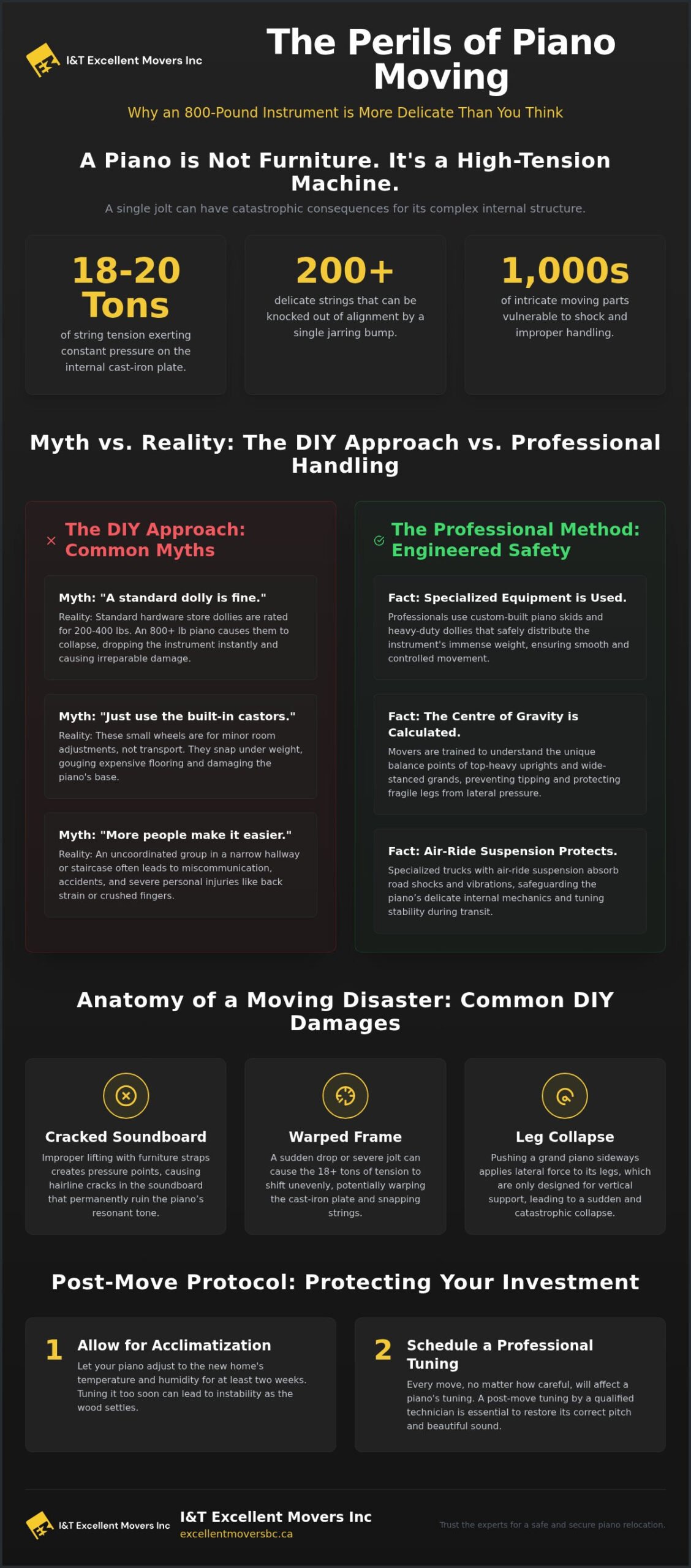
A piano is often the most valuable and heaviest item in a home, but it’s rarely treated with the same engineering respect as a vehicle or a furnace. Behind the polished finish lies a complex ecosystem of thousands of moving parts. The Hidden Complexity of Piano Moving stems from the fact that these instruments are high-tension machines. A standard piano contains over 200 strings, which together exert roughly 18 to 20 tons of pressure on the internal cast-iron plate. This immense force is what allows the instrument to produce its rich, resonant sound. However, this tension also means the piano is under constant structural stress. When you attempt a relocation without understanding these physics, a single jolt can cause that tension to shift, potentially warping the frame or snapping delicate internal components.
Understanding the Centre of Gravity
Most people realize that a piano is heavy, but few understand how that weight is distributed. Upright pianos are notoriously top-heavy because the majority of their mass, including the heavy cast-iron plate and the action mechanism, is concentrated in the upper half of the cabinet. This makes them prone to tipping if they’re tilted even slightly on an uneven surface. Grand pianos present a different challenge. Their weight is spread across a wide horizontal plane, but the legs are not designed to withstand lateral pressure. If a grand piano is pushed across a carpeted floor without being properly hoisted onto a skid, a leg snap can occur, causing the entire instrument to collapse. Professionals spend years learning how to calculate the exact pivot point for every turn, ensuring the weight remains balanced throughout the process.
The Fragility of the Soundboard
While the exterior cabinet is sturdy, the heart of the instrument is the soundboard, a thin sheet of spruce that is incredibly sensitive to pressure. Improper lifting techniques that place weight on the wrong part of the frame can create pressure points that lead to hairline cracks. These cracks are often invisible but can completely ruin the resonance of the instrument, leading to buzzing sounds or a loss of tone. Standard furniture straps, which work well for couches, can be disastrous for piano moving. If tightened across the wrong area, these straps can exert enough force to cause permanent structural damage to the soundboard or the delicate bridge. Relocating a piano is an act of precision engineering, not just a test of strength.
Myth vs. Reality: Can You Really Move a Piano with Friends?
It’s tempting to think that a few strong friends and a borrowed truck can handle the job. After all, many people view a piano as just another large piece of furniture. This misconception is exactly why many heirloom instruments end up with cracked legs or ruined finishes. When you’re Protecting Structural Integrity During the Move, you realize that a piano is a rigid, high-tension machine that doesn’t flex like a sofa does. A single mistake in physics can lead to a disaster that muscle alone can’t fix.
Several common myths often lead homeowners toward risky DIY attempts. First, the idea that “the castors are meant for moving” is a dangerous fallacy. Those small brass wheels are often decades old and were designed for minor adjustments on a stage or in a room. Using them to roll an 800-pound instrument across your Canadian maple floors can cause the wheels to seize or snap, leaving deep gouges that cost thousands to refinish. Another myth is that “more people make the job easier.” In reality, extra bodies in a narrow hallway or a staircase often lead to confusion and lack of clear communication, which is when most accidents happen.
The Danger of the DIY Dolly
Standard dollies found at local hardware stores are typically rated for 200 to 400 pounds. Since an upright piano can easily exceed 800 pounds, using the wrong equipment often leads to wheel collapse. This sudden failure can drop the instrument instantly, causing irreparable damage. Professional piano moving relies on specialized skids and boards that distribute the weight across a larger surface area. These tools are designed specifically to protect the instrument’s frame while allowing for smooth, controlled movement over ramps and thresholds.
Injury Risks and Liability
Beyond the risk to the instrument, the human cost of DIY is high. Back strain, crushed fingers, and foot fractures are common when amateurs attempt to lift such concentrated weight without proper training. If a friend gets hurt on your property, or if you damage a common area in a Vancouver condo building, you could be liable for significant costs. Choosing professional piano moving services ensures you’re protected by comprehensive insurance and WorkSafeBC coverage. The price of a professional move is often much lower than the cost of a floor repair or a single emergency room visit. Our team acts as your trusted guide, taking the physical and financial weight off your shoulders.
Specialized Equipment: Beyond the Standard Moving Truck
A standard moving truck is designed for boxes and appliances, but piano moving requires a mobile laboratory of protection. Professional crews don’t just rely on blankets; they use a combination of piano boards, skids, and heavy-duty slings. These tools ensure that the instrument’s weight is never concentrated on a single point, which could cause the wood to warp or the internal cast-iron plate to stress. In the Greater Vancouver Area, where architecture ranges from modern Tsawwassen condos to century-old heritage homes, specialized ramps are essential. These aren’t standard loading ramps; they are high-friction, reinforced surfaces that allow for a steady, vibration-free ascent or descent. Using the right equipment prevents the leg snap and wheel collapse risks mentioned earlier.
The journey itself is just as critical as the loading process. For any move, particularly with BC long distance movers, air-ride suspension is non-negotiable. This technology uses pressurized air bags to absorb road shocks that would otherwise jar the piano’s delicate internal action. Climate control also plays a vital role in protecting the instrument from BC’s coastal humidity. Rapid shifts in moisture levels can cause the soundboard to expand or contract, potentially leading to structural cracks. A professional environment keeps the wood stable from door to door, ensuring the instrument arrives in the same condition it left. This level of care is what distinguishes a specialized service from a general moving company.
Upright vs. Grand Piano Logistics
The technical approach varies by instrument design. Upright pianos use a rigid piano board to protect the cabinet and clear thresholds. Grand pianos require removing the lyre and legs before being placed on a padded skid. Professionals often use buckling to secure the internal action, preventing hammers from shifting during transit.
Navigating Tight Spaces in the GVA
Vancouver’s architecture often requires creative solutions like hoisting through balconies when stairwells are too narrow. Our crews use specialized rigging to manage these high-stakes lifts safely. A piano skid is a specialized weight-bearing platform designed to support the full mass of the instrument while providing a smooth surface for gliding over protective floor runners.
Protecting Structural Integrity During the Move
Safeguarding a piano’s integrity continues long after the movers have departed. Many owners are surprised to learn that piano moving involves a biological component because wood is an organic material that constantly reacts to its surroundings. If you’ve just moved through a damp morning in Tsawwassen to a dry, heated home in the city, your instrument needs time to breathe and stabilize. We recommend a strict ‘no-play’ period for at least the first 24 hours to let the internal components settle after the vibrations of transport.
Temperature fluctuations during the journey can cause the strings to expand or contract slightly. This shifting tension is the primary reason why a ‘move-proof’ tune is a myth. Every instrument requires a professional assessment once it has settled into its new atmosphere. Beyond the internal mechanics, where you place the instrument in your new home is vital for its long-term health. Avoid exterior walls, drafty windows, or direct alignment with heating vents. These locations cause uneven drying of the wood, which can lead to soundboard cracks or structural warping over time.
Vancouver’s Climate and Your Piano
Fraser Valley humidity levels often fluctuate wildly, which directly impacts the soundboard’s ‘crown.’ High moisture causes the wood to swell, pushing against the strings and sharpening the pitch. Conversely, BC winters often bring dry indoor air from baseboard heaters. This causes wood shrinkage, which can loosen the tuning pins and deaden the resonance. Maintaining a stable humidity level between 40% and 50% is the most effective way to protect your heirloom from the unique challenges of the Pacific Northwest climate.
Post-Move Maintenance Schedule
Don’t call your tuner the day after the move. We suggest waiting at least two to four weeks. This window allows the wood to reach an equilibrium with the local air. During this time, carefully inspect the pedals and internal action for any subtle shifting. If you are planning a full household transition, it’s helpful to integrate your instrument’s care with your broader residential moving services plan. This ensures the piano is handled with the same methodical precision as the rest of your home. For those relocating in the Richmond area, pairing your move with professional packing services in Richmond, BC can help ensure every item in your home, from fragile heirlooms to your instrument, is secured and organized before the moving crew arrives.
If you have questions about the best placement for your instrument, consult our expert piano moving team for personalized guidance and a stress-free relocation experience.
Choosing Your Professional Piano Mover in BC
Selecting a partner for your instrument’s journey involves more than simply finding a truck. While many general companies offer high-quality residential services, piano moving is a distinct discipline that requires specific training and heavy-duty equipment. You should always ask if a team uses specialized piano skids and whether their vehicles are equipped with hydraulic lifts. It’s also vital to confirm their insurance coverage specifically for high-value musical instruments. A general liability policy might not provide the full protection your heirloom requires. If your instrument is housed in a business or studio setting, the same principles that apply to commercial moving in British Columbia — careful planning, specialized equipment, and minimizing operational downtime — are equally relevant to protecting your investment.
Local knowledge is another critical factor in British Columbia. Manoeuvring through the steep inclines of the North Shore or managing the tight, restricted parking lanes in downtown Vancouver requires a team familiar with the local terrain. Our crews understand how to manage the logistical hurdles of the GVA, from heritage home staircases to modern high-rise elevator constraints. This expertise ensures that the move remains calm and methodical, preventing the rushed decisions that often lead to accidents.
Transparency in Pricing
We believe that clear communication regarding costs is essential for reducing move-day anxiety. When requesting a quote, be prepared to provide the piano’s height for uprights or length for grands, as well as details about the path. Common industry adjustments include:
- Stair Charges: These are applied when the crew must navigate flights of stairs or tight landings.
- Long Carry Fees: These are necessary when the distance between the truck and the door is exceptionally long.
Providing these details upfront allows for a flat-rate quote, which offers much better peace of mind than an hourly estimate that could fluctuate. When the logistics are planned in advance, there are no surprises on the day of the relocation.
The I&T Excellent Movers Inc Advantage
Our team treats every instrument as a piece of history. We specialize in the precise logistics of heavy instrument transport, serving communities from Tsawwassen to the North Shore and throughout the Greater Vancouver Area. By combining modern equipment like air-ride suspension with a compassionate, service-oriented approach, we ensure your piano arrives safely and sounds its best. If you’re ready to protect your investment with a team of trusted expert guides, you can Contact I&T Excellent Movers Inc to book your stress-free move today.
Ensuring a Harmonious Transition for Your Instrument
Relocating a piano is a feat of engineering that requires a deep understanding of physics and mechanical tension. We’ve explored how these delicate instruments are susceptible to internal damage and why standard furniture moving techniques often fall short. Professional piano moving provides the specialized care your instrument needs to survive the journey intact, protecting both the polished exterior and the complex internal mechanics.
Our experienced GVA crews utilize specialized piano skids and boards to ensure every turn and lift is handled with methodical precision. With fully insured transport and a fleet designed for stability, we take the physical and mental burden off your shoulders. If you’re ready to move your instrument with the care it deserves, Get a Professional Piano Moving Quote from I&T Excellent Movers today. We’re here to guide you through every step of your relocation, ensuring your piano arrives safe, sound, and ready for its next performance. Your peace of mind is our priority as you settle into your new home.
Frequently Asked Questions
How much does piano moving typically cost in Vancouver?
The cost of piano moving in Vancouver depends on the instrument’s size and the complexity of the route. Factors such as whether you have an upright or a grand piano, the distance of the travel, and the presence of stairs will all influence the final estimate. Professionals typically assess these variables to provide a flat-rate quote that ensures there are no hidden fees on the day of your relocation.
Will my piano go out of tune when it is moved?
Yes, your piano will likely require tuning after a relocation. This isn’t usually caused by the physical movement itself, but by changes in humidity and temperature between the two environments. The wood and strings react to the new atmosphere, causing the pitch to shift. Professional piano moving in climate-controlled trucks helps minimize this impact, but it won’t eliminate the need for a post-move adjustment.
Can regular residential movers handle a grand piano?
Most general residential movers lack the specialized equipment and training required for grand pianos. Moving a grand requires partial disassembly, including the removal of the legs and lyre, which is a technical manoeuvre. Without specific tools like a grand piano skid and padded slings, there’s a high risk of structural damage or personal injury. It’s best to ensure your crew has specific experience with high-tension instruments.
What information do I need to provide for a piano moving quote?
To get an accurate estimate, you’ll need to provide the piano’s type and dimensions. For uprights, measure the height; for grands, measure the total length from the keyboard to the bow. You should also describe the path at both locations, noting any stairs, narrow turns, or grass surfaces. Clear details about elevator dimensions or tight landings in Vancouver condos help the team plan for the correct equipment.
Is it possible to move a piano on its side?
Grand pianos are designed to be moved on their side once they’re secured to a specialized piano board or skid. However, you should never attempt this with an upright piano. Tipping an upright on its side can cause the internal action to shift or the hammers to break. Professionals always keep uprights in their natural vertical position to protect the thousands of delicate moving parts inside the cabinet.
How long should I wait to tune my piano after a move?
You should wait between two and four weeks before scheduling a tuner. This period allows the wood and soundboard to acclimate to the humidity levels of your new home. Tuning the instrument too early is often a wasted expense, as the strings will continue to shift as the wood settles. Budgeting between C$100 and C$300 for this post-move service is standard for most Vancouver owners.
What happens if a piano doesn’t fit through the stairs or elevator?
If a piano cannot fit through conventional paths, professional movers may suggest a hoisting or crane service. This involves safely lifting the instrument through a window or over a balcony using specialized rigging. While this adds to the complexity, it’s a common solution for heritage homes or modern apartments in the Greater Vancouver Area. Professionals assess these challenges during the initial consultation to prevent any surprises on move day.
Does professional piano moving include insurance for the instrument?
Yes, reputable specialists provide comprehensive insurance coverage for your instrument. Many professional movers in BC offer liability coverage that can reach up to C$100,000, protecting you against accidental damage during transit. You should also verify that your mover is WorkSafeBC certified. This ensures that the crew is protected and that you aren’t held liable for workplace injuries that might occur on your property.